The Indian economy can grow if it is delinked from the slow growth in the West and the deceleration in China, says Ashok K Lahiri.

'The missile mounted near Kailash-Mansarovar is called DF-21. It is a medium-range, 2,200 kilometres ballistic missile. Its advantage is that it can cover all cities of north India, including New Delhi'

'Nehru was singularly clear sighted about the international political situation.'

'The numbers of troops on both sides are enormous.' 'They are about 50,000-60,000 soldiers facing each other in that sector -- that's about the total number of troops that both sides had in the 1962 War in all sectors.'
Indians must remember that Pakistanis hate losing to India, at war or in cricket, says Sanjeev Nayyar.

''There is the perennial worry in the Indian mind regarding the US 'hyphenating' India and Pakistan. Frankly, this is a completely nonsensical hypothesis. The US has always 'hyphenated' India and Pakistan and it couldn't have been otherwise,' says Ambassador M K Bhadrakumar.

China's intended role for AIIB is not so different from the existing Western lenders like the World Bank.

This means lower losses on fuel sales by Indian oil companies and a shrinking oil subsidy bill for the government.
India's commitment to an open and plural security architecture attests to the fact that Asia's transition is a dynamic of both power & identity, says Zorawar Daulet Singh

'The men in black suits and hair dye in Beijing have not only completely blown the cover story of "peaceful rise," but have managed to antagonise regional powers in the Indo-Pacific.'
'The heart of the matter is that India is not Israel.'

Kuala Lumpur's delay in roping in India to help track the missing aircraft is an indicator that New Delhi must redouble its diplomacy and capacity demonstration in East Asia, feels Nitin Pai
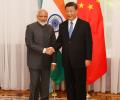
'The fact that Modi and Xi exuded confidence to accelerate the negotiations for a border settlement alone underscores that the Russia-India-China triangle has become very dynamic,' notes Ambassador M K Bhadrakumar.

Given that India will get a huge part of its oil supplies from Iran through its government-owned oil PSUs, any unwelcome shocks in global crude rates could be absorbed well enough.

Just like China wants Trump to lose the US presidential poll, it may want Modi to lose the Lok Sabha polls. So months before the 2024 elections, China may take possession of an important area, say one of the Char Dhams, warns Sanjeev Nayyar.

'If the US intention was to use the FATF platform to isolate Pakistan and impose sanctions against it, that is not going to work when influential countries such as Turkey, Iran, Saudi Arabia, China and Russia will not lend support to the US campaign,' says Ambassador M K Bhadrakumar.

Asserting that "maritime muscle flexing" by some countries and other factors have made the Indo-Pacific region "more contested and more volatile," naval chief Admiral Sunil Lanba on Tuesday said that the Indian Navy has its task cut out as it has been a major security provider in the region.

'Modi's recent decisions to improve India-China relations, adjust India's neighbourhood policies and to rebalance India's ties with the major powers are linked to his political agenda.' 'Of course, the good part is that this agenda is also in the national interest,' says Ambassador M K Bhadrakumar.
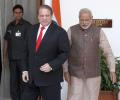
'Instead of isolation, India should respond militarily to every act of terrorism assessed to have come from across the border, unilaterally declare Pakistan a State that supports terrorism and cease all economic dealings with it.'

This is the first time Pakistan and Kashmir have been brought into the narrative.

When a Chinese warship entered Japanese waters, the Indian commander called on China to maintain discipline at sea. Dr Rajaram Panda explains the significance of the Malabar exercises between India, Japan and the US.

'Both Modi and Xi know that if all that there is to show for Modi's visit -- barely eight months after Xi's India trip -- is a repeat of the same old declarations, there will be a terrible sense of letdown in the public mood resulting in future summits losing credibility. Only the possibility of new ground being broken can justify Modi's trip at this time,' says B S Raghavan.

Indians at large harbour a notion that their country is cherrypicking out of the American basket of goodies, but the policymakers in Delhi and the political leadership are well aware that it can only be a pipe dream since a military alliance with a superpower is a profound irrevocable commitment, observes Ambassador M K Bhadrakumar.
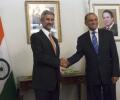
Pakistan's holy trinity -- its government, military establishment and the ISI -- differ on Pakistan's domestic and foreign policy issues. So when India talks to Pakistan's political leadership it can't be sure that the promises can be delivered, says Brigadier S K Chatterji (retd).

The US foreign and security policy establishment, says Ambassador M K Bhadrakumar, apprehends that Trump may compel them to exorcise the 'unipolar predicament', and bring foreign and security policies to reflect the desires and priorities of the American public.
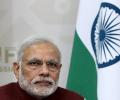
'There is nothing that Pakistan has done which deserves a resumption of dialogue. The assurances made in Ufa contain no commitment except a whole range of talks, which could take place without the paraphernalia associated with a joint statement of prime ministers.'

'What gives hope is that Modi's own leadership is vitally linked to his capacity to deliver on the economic front. Indeed, if he succeeds, India's foreign policies will have changed beyond recognition,' feels Ambassador M K Bhadrakumar.

'How can Kashmir be demilitarised if the terrorist threat remains and Pakistan continues to incite elements in Kashmir to keep the internal situation unstable?' asks former foreign secretary Kanwal Sibal.

'It is in the interest of both sides that the visit of the US President is seen as being successful. Both sides have invested considerable political capital in it. This rapid exchange of visits and the decisions taken have to be justified, beyond the symbolism, which is no doubt important in itself. This opportunity to impart a fresh momentum to ties should not be missed,' says former foreign secretary Kanwal Sibal.
'Greenpeace has been brutal in targeting both India and the Manmohan Singh government. The push to go after Indian coal is driven by its long-term agenda. What is surprising is that China has not been meted out the same treatment, despite the fact that the rise of China as an economic power has been built around generating power from coal. 'Being richer and more affluent, yet far less democratic, there is less room for an NGO such as Greenpeace to drive home a complicated global agenda, so there is more of a tendency to go along with anything the Chinese offer despite China being the biggest by far with regard to coal use. But for India, it reserves tougher prescriptions, notably for its middle class, says Srinivas Bharadwaj.

New Delhi and Beijing are the only two regional capitals that have commented on US President Donald Trump's speech on August 21 outlining the way forward in Afghanistan. The Indian foreign ministry statement was effusive in praise, while the Chinese statement has been one of cautious and guarded hope. Delhi has identified itself with Trump's Afghan strategy, whereas the Chinese stance is calibrated -- observant and objective, keeping a distance, says Ambassador M K Bhadrakumar.

'Our approach to India is no different from the approach that we have made in India over the years, recognising its non-aligned status. That's their decision; we're not trying to change that. We have common interests, and we have actually built on those common interests... We think there's more potential to build on those common interests.' 'Security, stability, freedom of sea lanes, economic development, energy, all those are certainly in the interest of India and the region, as they are to the United States.' The transcript of US Secretary of Defence Chuck Hagel's interaction with reporters travelling with him hours before he landed in New Delhi on Friday on a three-day visit to India.

'The real test will be in defence-related deals, for instance the Javelin anti-tank missile: Is the US willing to co-develop something with India, on terms that will support the 'Make in India' initiative? Is there defence technology transfer? Or will it dump old junk on India?' asks Rajeev Srinivasan.

'India was in no position to wage another war in 1965, having suffered a morale-shattering defeat in 1962. The three services were in the middle of a modernisation and expansion phase and therefore not fully trained or battle-ready.'

'Whether it's investments in Kashmir, building naval facilities, or selling top-of-the-range military equipment, Pakistan could well benefit more under Xi's watch.' 'Do Chinese concerns about the 'Islamisation' of Pakistan give it pause about how quickly to move forward with security and economic projects? At the moment the indication is quite the opposite: China is doubling down on its support to Pakistan, partly because of its fears about where the country is headed.'
